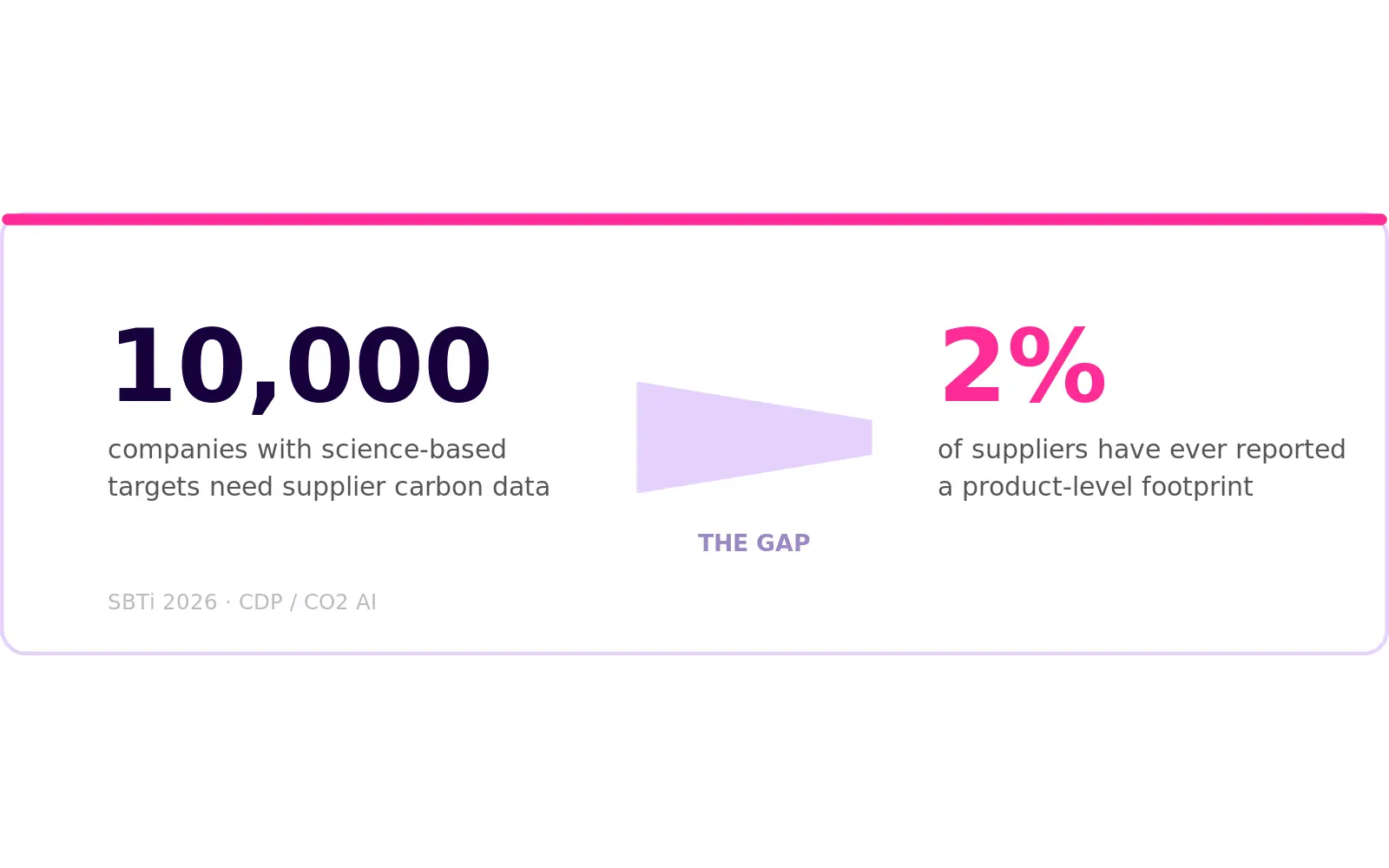
10,000 companies want supplier carbon data. 2% of suppliers can deliver it.
Nearly 10,000 companies hold science-based targets, yet only 2% of suppliers have ever reported a product-level carbon footprint. Two Fortune 500 OEM programs hit 82% and 100% supplier response in under four weeks by asking for raw data over email instead of finished PCFs.

Miguel Altamirano
Go-to-Market, Sluicebox
Published
June 11, 2026
Almost 10,000 companies have committed to science-based climate targets, and 96% of those targets cover Scope 3. To report those emissions, every one of them needs carbon data from their suppliers.
CDP alone carries 270+ buyers requesting data from roughly 45,000 suppliers a year, and the hyperscalers, OEMs, and component buyers I talk to every week are asking for the same data to hit their own decarbonization goals.
Here is the supply side: 2% of suppliers have ever reported a product-level footprint to CDP. So everyone is asking for PCFs, but almost no supplier is providing them.
The organizations that close this gap hit their 2030 numbers. Everyone else will stay behind.
The ask is the failure. Most suppliers can't produce PCFs.
The traditional approach: implement a supplier portal, load your supplier list, send the questionnaire, ask each supplier to type in their PCF.
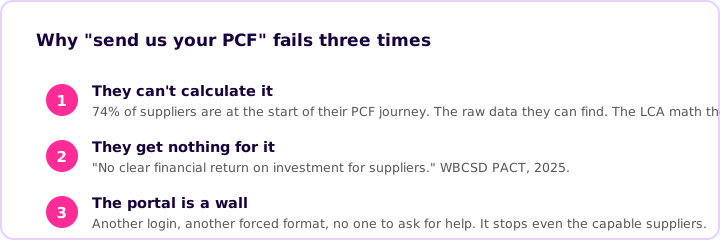
Three things break.
1. Suppliers can't calculate PCFs. 74% are at the beginning of their PCF journey, and an ISO-conformant footprint takes six months + specialist LCA expertise most will never hire.
On the other hand, suppliers do know how to find their primary raw data, the weights, electricity bills, and transport records. The ISO-aligned calculation is where they struggle.
2. Suppliers have little incentive to go through the effort to calculate a PCF. PACT, the body writing the data-exchange standards, said it plainly in 2025: "There is no clear financial return on investment for suppliers to invest in PCF calculations."
3. The portal itself is a wall. I spent years at SAP. The last thing a supplier wants is another portal: another login to maintain, another forced format, another questionnaire with no one to ask for help. So even the suppliers who could answer, often don't.
Some suppliers do answer anyway. That creates the second problem.
The numbers that come back won't survive an audit
Ask for a kgCO2e figure and many suppliers could send one. The problem sits behind the number: no system boundary, no methodology, no data quality rating. A supplier to one Fortune 500 OEM told us they had calculated theirs with ChatGPT.
The research says that is the norm. A Springer study of 25,000+ supplier disclosures found self-administered questionnaires produce "less accurate reporting and overly positive self-assessment."
Supplier programs report response rates. Auditors ask a different question: can the number survive verification? Getting your internal PCF methodology ISO 14067-accredited takes months to years. A supplier doing the math alone, once, for a few customers, never gets there.
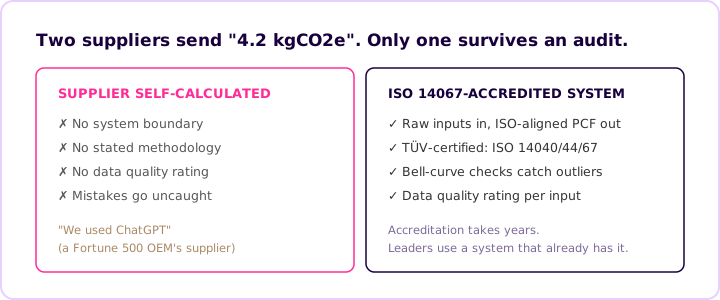
Both problems disappear the moment you stop asking suppliers for the answer and ask for the ingredients instead.
Leading buyers ask for raw data, in the inbox
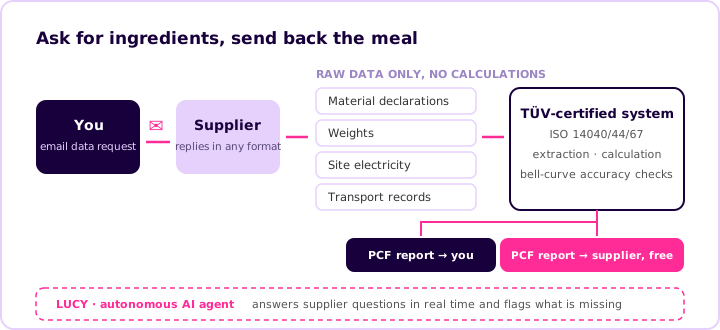
The buyers getting real audit-ready data flipped the request. Instead of a finished PCF, they ask for the primary raw data suppliers already know how to find: material declarations, weights, site electricity, transport records.
The ask happens via Lucy, Sluicebox's autonomous AI agent: over email, in any format. ERP exports, old LCA reports, utility bills, half-finished spreadsheets, even a plain text reply with the right numbers in it. Only the fields the calculation needs are extracted, so commercial data (pricing, yields, sub-suppliers) never reaches their customer.
The calculation runs centrally on a TÜV-certified system for ISO 14040/44/67, with bell-curve analysis against comparable submissions catching outliers and honest mistakes. And the supplier gets back a finished PCF report at no cost: the deliverable a consultancy would charge $8,000 to $10,000 for.
That last step incentivizes the supplier to respond. It also answers the question PACT left open: who pays.
What makes it scale is Lucy running the conversation autonomously. She answers supplier questions in real time, inside their inbox: where the data usually lives, what counts as primary, what is still missing. The guidance the portal never gave, from something that behaves like an LCA expert on call. No login. No template.
Does it work? The numbers say so.
Give the supplier something back and 8 in 10 respond
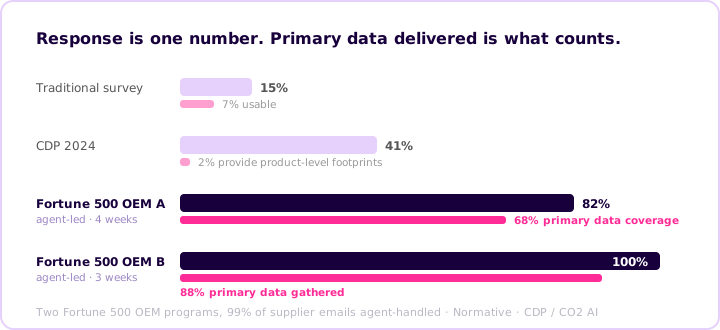
Two Fortune 500 OEMs ran this motion recently. The first reached 82% supplier response and 68% primary data coverage in four weeks, end to end. The second reached 100% response and 88% primary data gathered in three weeks. Weeks, against the six months a self-built PCF takes. Across both programs, 99% of supplier emails are handled by the agent, no human involvement.
Traditional supplier surveys get roughly 15% response with 7% usable data. CDP reached 41% response in 2024, but on the question that matters here, product-level footprints, only 2% of suppliers have ever delivered one.
The suppliers noticed too. "Very simple now compared to earlier stage," a hardware supplier told one of these OEMs. A motor and components supplier called the free PCF report "strong value for our team."
Same suppliers. Different ask. Ten times the usable data.
The channel outlives the question
The pattern across everything above: every failure traced back to the ask. Asking for raw data instead of finished footprints removes the capability problem. Guiding suppliers in their inbox removes the portal problem. Sending back a free, audit-ready PCF report removes the incentive problem. Remove all three and response moves from 15% to 80%.
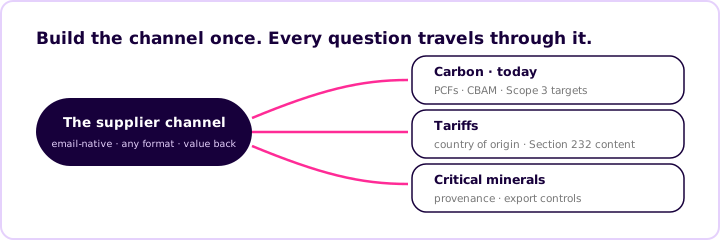
Now the part I find most interesting. Carbon is only one of the use cases. The same suppliers now owe their customers country-of-origin data under Section 232 tariffs, critical-minerals provenance, and CBAM declarations.
Each is the same act: a supplier handing primary data to a customer, in whatever format they have. I wrote about the tariff side here.
A data gathering approach that works supports every requirement that comes next.
Sources
- Science Based Targets initiative, Target dashboard, 2026
- CDP, Strengthening the Chain, 2024
- CO2 AI, Call to action: product-level data is crucial to address Scope 3 decarbonization
- Manufacture 2030 (Secaro), Are Product Carbon Footprint standards outpacing suppliers?, 2025
- WBCSD PACT, Exploring Underlying Barriers to Tech-Enabled PCF Data Calculation and Exchange, 2025
- Fraser, Müller & Schwarzkopf, Dear supplier, how sustainable are you?, Sustainability Management Forum, Springer, 2020
- CO2 AI, Build vs Buy: The Real Cost of Scope 3 Supplier Data Collection
- Normative, Scope 3 Supplier Engagement: Primary Carbon Data
About Sluicebox
Sluicebox is the Supply Chain Intelligence layer for the electronics industry — a Dynamic LCA engine designed specifically for semiconductor and electronics manufacturers, suppliers, and brands. Sluicebox automates and scales product-level carbon footprint (PCF) calculations and reporting across complex global supply chains, delivering real-time, ISO-compliant, and audit-ready carbon data for over 99% of electronic components worldwide.
Developed by engineers and scientists from NASA, Amazon, and Uber, Sluicebox empowers organizations to identify emissions hotspots, ensure regulatory compliance, and build trusted sustainability disclosures — eliminating the cost and complexity of manual life cycle assessments.
More news
 Industry Analysis
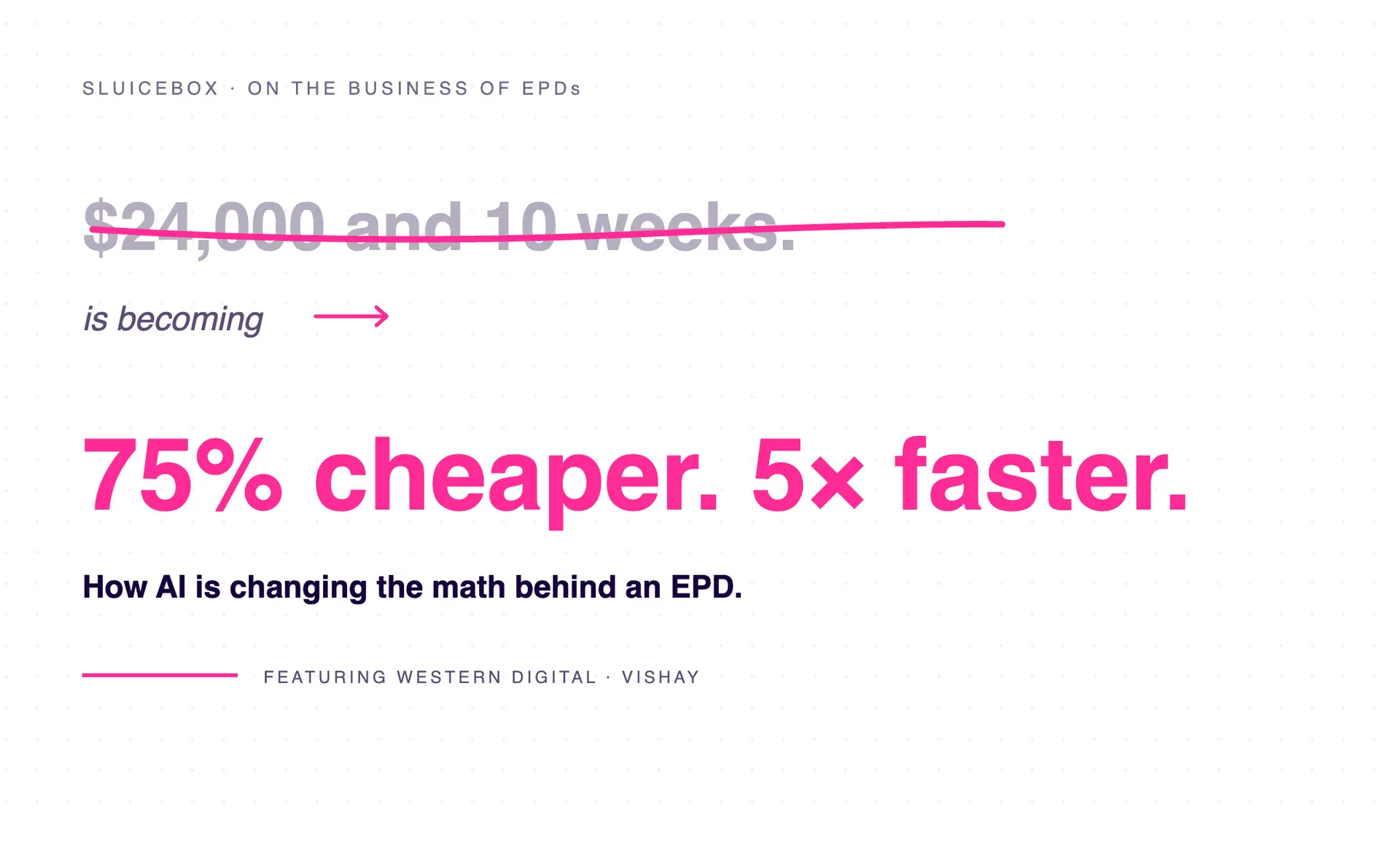
An EPD costs $24,000 and ten weeks. AI is changing the math.
 Miguel Altamirano5 min readJune 10, 2026
 Press Coverage
TÜV SÜD evaluates AI-based LCA software
 TÜV SÜD10 min readNovember 26, 2025
 AI & Engineering
Distance From the Outcome: Why AI Threatens Some and Supercharges Others
 Adrien Brault12 min readFebruary 4, 2026