Trellis Impact 26: What I Heard
Notes from Trellis Impact 26 in San Francisco: 2,500 attendees, 500+ speakers, 123 sessions. Energy is the constraint the industry is planning around, Scope 3 and LCA work is being automated, and Western Digital showed a supplier data program that went from 30% to 90% primary data coverage and from five to six months down to four weeks.

Elmar Kert
CEO & Co-founder, Sluicebox
Published
July 7, 2026
By Elmar Kert, Co-Founder & CEO, Sluicebox
June 23 to 25, 2026. Moscone West, San Francisco. Roughly 2,500 attendees, 500+ speakers, 123 sessions across seven tracks. Trellis Impact is one of the largest sustainability and climate events in North America, and this year's agenda told a very specific story about where the industry is headed.
Here is what stood out.
Energy is the bottleneck everyone is planning around
Data center demand shaped the agenda. Meta presented how it approaches the full data center stack, from buildings to hardware, and said openly it is looking for startups to work with. NVIDIA and Equinix held keynote slots. The conversation was speed to power: batteries, microgrids, and getting projects connected faster. Energy access is being treated as a competitive constraint, not just a sustainability goal.
The startup pitch competition reflected this. One of the three category tracks was dedicated entirely to data center solutions, with Airloom Energy winning that category for modular wind systems designed for data center proximity.
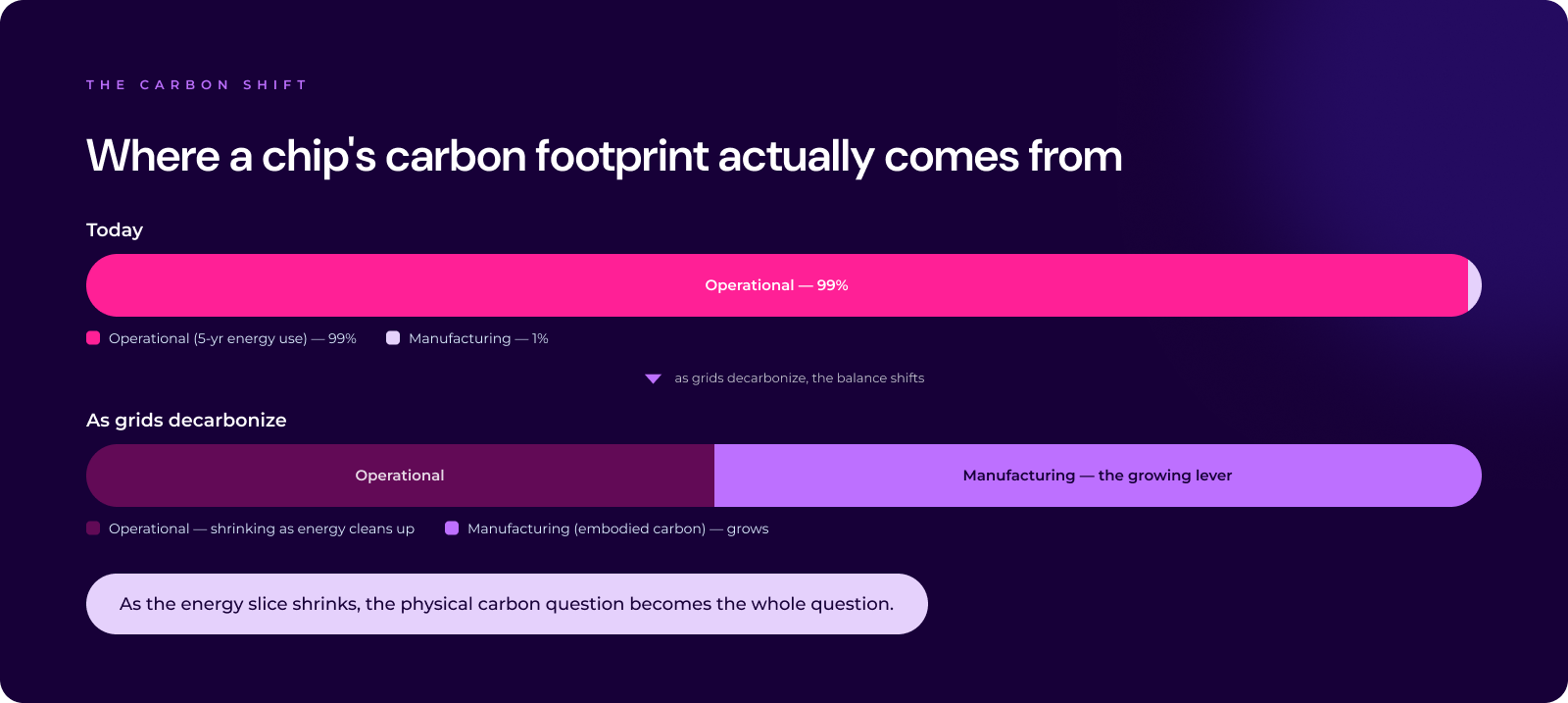
What makes this interesting from a carbon perspective is that it is actually setting up a shift. Right now, the power consumption and carbon emissions associated with operating a data center outpace anything you purchase to build it. A single NVIDIA graphic card has a meaningful manufacturing footprint, but the energy it consumes over the next five years accounts for roughly 99% of its total lifecycle emissions.
However, as the industry moves closer to renewables and nuclear, that operational slice of the pie will shrink. We see it shrinking already. What will be left is the physical carbon piece. How is the hardware manufactured, where is it made, what materials go into it, what are the design choices. That is where the non-use phase parts of product carbon footprints become the dominant question, and that is where we live.
Scope 3 and LCA work is being automated
Two years ago, automated life cycle assessment was a niche pitch. At Trellis this year, it shared a stage with sustainable aviation fuel. The "Cracking Scope 3" session featured TE Connectivity, Cummins, and Alaska Airlines on the same panel discussing strategies that deliver real reductions.
Part of what changed is that massive customers are now asking for it. Three years ago, we came off that European ramp of regulations from a corporate carbon perspective. Now there is real demand beyond just European regulation. Cummins, for example, makes backup generators for Amazon, Microsoft, and the other hyperscalers. Once there is a power outage, it cannot take longer than a split second for one of those generators to kick in and power the racks. The companies making that critical infrastructure are now being asked by their customers to provide primary carbon footprints, not just spend-based estimates that often overcount or undercount emissions.
Despite more companies asking for it, the complexity of answering these disclosures has not been fully solved. It is still common for one person to get hired, be given SimaPro, a legacy software tool that consultants have used for years, and face a really slow climb through data gaps and manual processes. When you consider that an EPD costs $24,000 and ten weeks through traditional methods, the math does not work at scale.
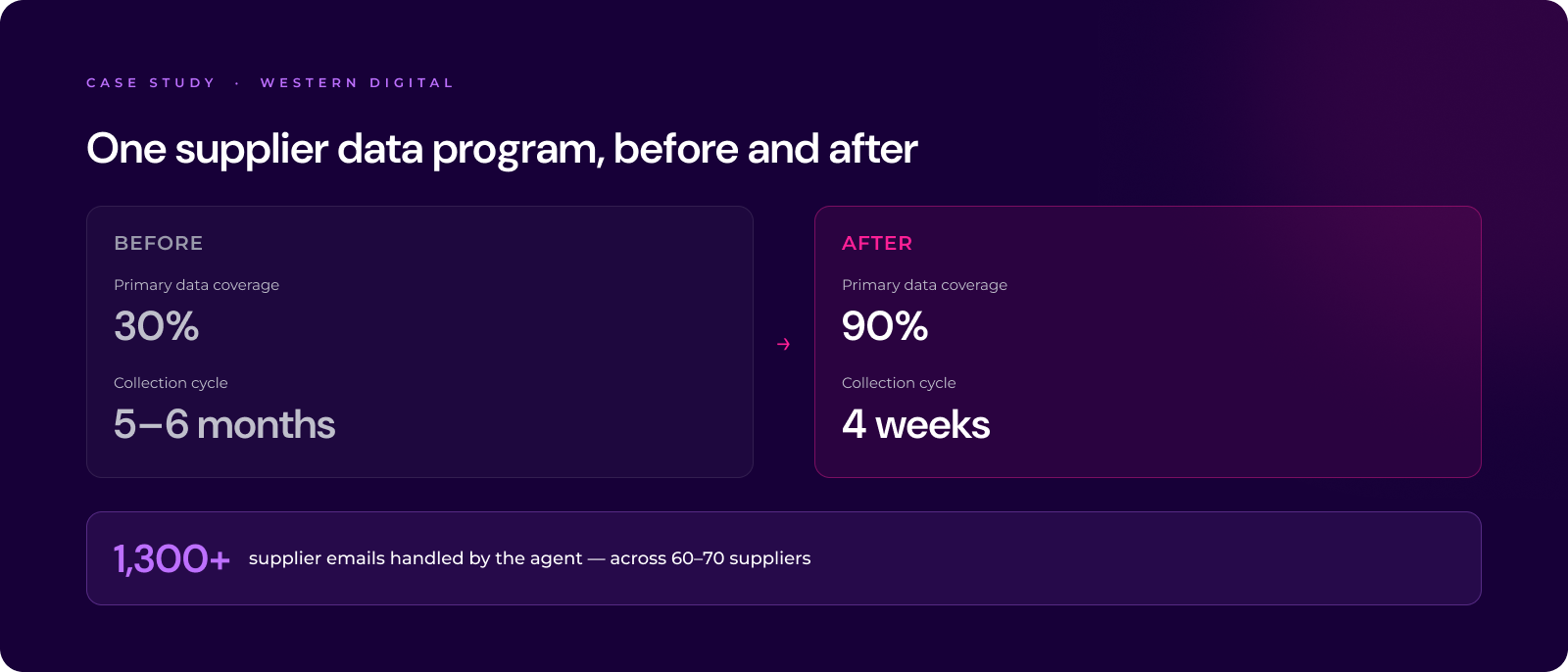
Western Digital presented at the AI x Sustainability Showcase on how they deployed an agentic workflow for supplier data collection. They went from 30% to 90% primary data coverage and shortened their data collection cycle from five to six months down to four weeks, across 60 to 70 suppliers. Mrinalini Iyer from their Sustainability Operations team walked through the deployment, including how the AI agent guides suppliers to collect raw data and converts it into ISO-standard product carbon footprints within the email chain itself. The supplier does not have to log in to another portal or spend time filling out another form.
That is Sluicebox Mrinalini was presenting. It is built on the same platform we use across all our customers, including Vishay Intertechnology, where we accelerated their primary data collection and improved accuracy using the same AI-driven approach.
One thing that came up during the Q&A was buy-in. Sustainability is often still seen as a cost center, and people are still trying to find the ROI. What made the difference in Western Digital's case was the labor savings. Over 1,300 supplier emails were handled through the agent. When you quantify the hours saved across that volume, the buy-in discussion gets a lot shorter.
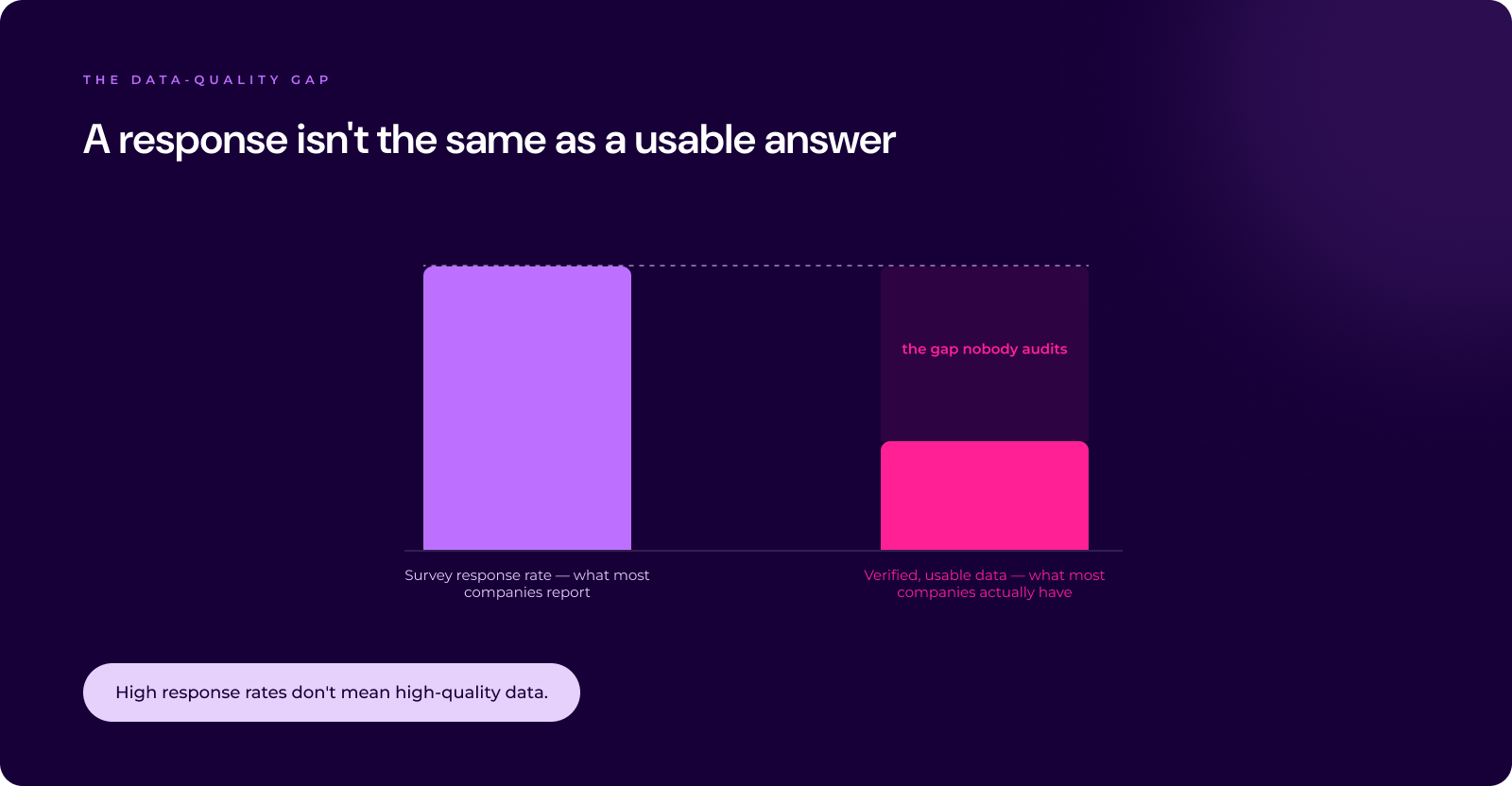
There was also an honest moment about response rates. We spoke to other companies at the conference who said they get very high response rates from their supplier surveys. But the reality is that a response does not mean usable data. Many companies are comfortable treating a response as enough without auditing whether the data behind it is actually accurate or complete. That gap between claimed coverage and verified coverage is still wide across the industry.
The buyer sophistication gap is real
There were seven dedicated AI and sustainability sessions at Trellis. What our team observed across multiple sessions is that when companies were presenting the technology they had adopted, like dashboards for tracking sustainability metrics, they often had no idea what was actually going on behind it. They knew the outcome but not the methodology. When auditors asked questions about the technology, the answers were vague.
This matters because it means the market for AI-powered sustainability tools is moving faster than many buyers can evaluate. Teams are making purchasing decisions without fully understanding what differentiates one tool from another. This is something we have written about before. The distance between a buyer and the actual outcome of a tool determines whether AI accelerates their work or just adds another layer of opacity. Verified and auditable customer outcomes carry more weight than product claims.
Circularity is now a compliance function
EPR enforcement is real money. State programs in Colorado, Maine, and Oregon carry penalties up to $25,000 per day. California textile EPR is coming. Trellis framed circularity as regulatory reality rather than aspiration.
EY ran a panel with John Deere, Mattel, and Amazon on turning EPR compliance into advantage: source reduction, ecomodulation, and using EPR modeling to drive packaging decisions instead of treating it as a siloed compliance exercise.
One thing worth noting about circularity that does not get discussed enough: going circular does not automatically mean lowering your carbon footprint. Sometimes virgin products are cheaper and sometimes have a lesser footprint than recycling the same material over and over, because you need to add certain additives and energy back into the mix. Companies need the ability to model these tradeoffs, not just assume that circular equals lower carbon.
In data centers specifically, circularity runs into a unique constraint. You cannot just take one hard drive out of one data center and reuse or re-sell them because of data sanitization and chain-of-custody requirements that make re-sale harder. This often leads to shredding, and then all the rare earth minerals and materials are mixed together. Separating them again is expensive and energy-intensive. This is an area where simulation tools that can model the carbon impact of different end-of-life scenarios become genuinely useful.
Electronics circularity got specific
Battery circularity had its own panel featuring UL Solutions and Redwood Materials, focused on where the gaps are in reuse and recycling and which policy levers actually move the needle. ABB ran a workshop on repairability and designing for longevity from the earliest stages of product design. Electronics recyclers like Dynamic Lifecycle Innovations were on the floor connecting data center growth to end-of-life hardware volumes.
Net zero standards are resetting
SBTi Corporate Net-Zero Standard V2.0 was the side-event topic. 3Degrees hosted a breakfast on adapting to it, and the supplier engagement requirements in V2 push more companies toward primary supplier data.
Is SBTi V2 the single biggest tailwind for primary data collection? It is definitely one. Primary data is something a lot of companies and suppliers want, and not just for carbon. If you can collect primary data from an entire supply chain for material flows, energy consumption, and manufacturing processes, there is value beyond just producing a carbon footprint number. The primary data collection trend that is unfolding right now goes well beyond any single standard.
The conversation that stayed with me
I met another founder at Trellis who had gone through a journey that felt familiar. Jay Sadiq from 40Guard started by looking at urban heat hotspots, in the Middle East and then Los Angeles, and developed a type of concrete that absorbs less heat. He took it to city councils and they said, "Great, but where should we put it?" They did not know where the hotspots actually were.
So he started mapping temperature. He tapped into every car, every scooter, every Lime scooter, because all batteries have temperature sensors. He built a near real-time temperature map of entire cities. When he went back to the councils, everyone wanted to buy the map instead of the concrete. He sold the concrete company. Now he purely focuses on the temperature data.
I think we are in a similar space. Carbon is a great wedge for us. It is increasingly important. But as we gather primary data from suppliers, as we build product knowledge about what makes up a data center or a consumer electronics device, there is a similar pathway. The data you collect to solve one problem becomes the platform for solving many others.
That was a bit of an eye-opening moment. Seeing yourself in third-person perspective.
Elmar Kert is Co-Founder and CEO of Sluicebox. Sluicebox helps electronics and semiconductor companies collect primary carbon data from their supply chains and generate TÜV-verified product carbon footprints.
About Sluicebox
Sluicebox is the Supply Chain Intelligence layer for the electronics industry — a Dynamic LCA engine designed specifically for semiconductor and electronics manufacturers, suppliers, and brands. Sluicebox automates and scales product-level carbon footprint (PCF) calculations and reporting across complex global supply chains, delivering real-time, ISO-compliant, and audit-ready carbon data for over 99% of electronic components worldwide.
Developed by engineers and scientists from NASA, Amazon, and Uber, Sluicebox empowers organizations to identify emissions hotspots, ensure regulatory compliance, and build trusted sustainability disclosures — eliminating the cost and complexity of manual life cycle assessments.
More news
 Industry Analysis
An EPD costs $24,000 and ten weeks. AI is changing the math.
 Miguel Altamirano5 min readJune 10, 2026
 Press Coverage
TÜV SÜD evaluates AI-based LCA software
 TÜV SÜD10 min readNovember 26, 2025
 AI & Engineering
Distance From the Outcome: Why AI Threatens Some and Supercharges Others
 Adrien Brault12 min readFebruary 4, 2026