AI in LCA: What's Real and What's Hype, According to Vishay and Fraunhofer IZM
Notes from the Sluicebox panel at ACLCA 2026 in San Diego. Vishay has completed around 7,000 product carbon footprints, with requests growing about 10% every quarter, and tested AI results against three full manual LCAs before scaling. Fraunhofer IZM's first AI-assisted LCA held up against conventional modeling.

Elmar Kert
CEO & Co-founder, Sluicebox
Published
September 30, 2026
I moderated the Sluicebox panel at ACLCA 2026 in San Diego, and started with a quick show of hands.
How many people in the room had used an AI-assisted LCA in the past month? A handful of hands went up, maybe five. And how many had actually put one in front of a customer? One hand. It belonged to someone on my own team.
"We have trust issues," I joked. It got a laugh, and it also set the tone for the next hour and a half.
Next to me were two people who have had to work through that same doubt on the job. Susan Monroe leads sustainability and ESG at Vishay, a component manufacturer that makes millions of parts. Kim Eschenbach is a researcher at Fraunhofer IZM, where her department studies the environmental side of electronics. One sits on the disclosure side of an LCA and the other on the modeling side, and that mix made for a very honest conversation.
Key takeaways
- Vishay has completed around 7,000 product carbon footprints, and requests keep growing by about 10% every quarter.
- Before scaling, Vishay tested AI results against three full manual LCAs.
- Fraunhofer IZM's first AI-assisted LCA held up well against conventional modeling, and the biggest error came from the input, not the model.
- Neither panelist would trust a general AI chatbot to produce a PCF.
The Problem Is Volume, Not Methodology
For Susan, it usually starts with a customer request. Someone downstream is working on their Scope 3 numbers, and they need a product carbon footprint from Vishay to do it. Sometimes that means one part. Often it means a lot more.
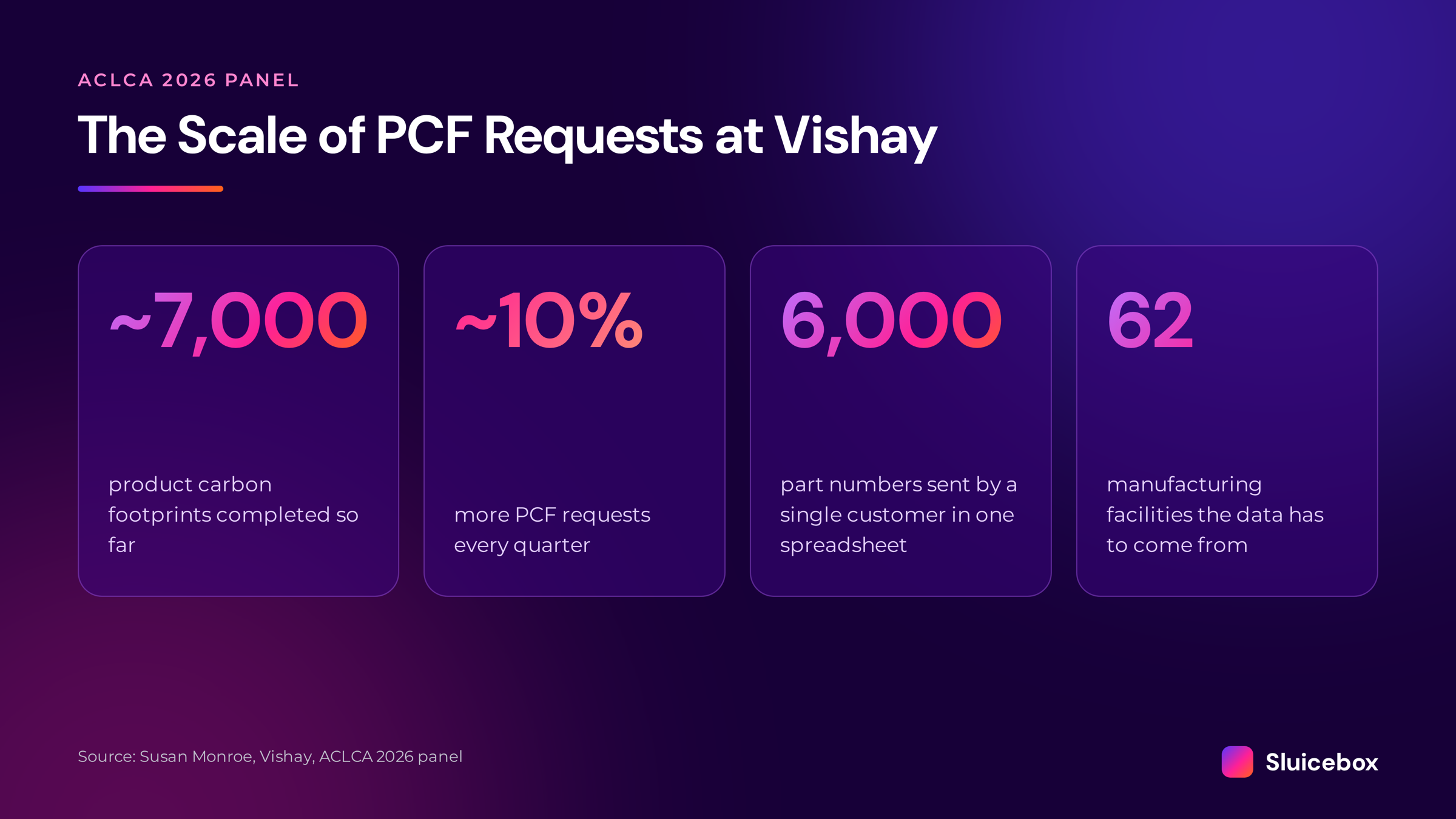
Vishay has completed around 7,000 PCFs so far, and the requests keep climbing by roughly 10% every quarter. One customer sent a single spreadsheet with 6,000 part numbers on it, spanning everything from passives to semiconductors and drawing on Vishay's 62 manufacturing facilities.
I knew the feeling. Before starting Sluicebox, I tried to run many LCAs at once at AWS and found it hard going. Telling customers to wait isn't really an option either, as Susan pointed out.
"Just saying no is not an option for us."
Susan Monroe, Director of Sustainability and ESG, Vishay
So what is Susan actually short of? Time, Susan said, without hesitating. If every one of those footprints had needed a full manual LCA, "we would still be on number 50 right now."
The data doesn't make it any easier. Vishay has grown through acquisitions, so each site stores its information a little differently. Many of those sites had never been asked for this kind of data before, which meant a good part of the job was explaining what was needed and why.
Vishay's far from the only one dealing with this. Across electronics, product-level carbon data is becoming a normal part of doing business, and some buyers, like Bosch, now ask for a carbon number with every RFQ.
How Vishay Learned to Trust the Numbers
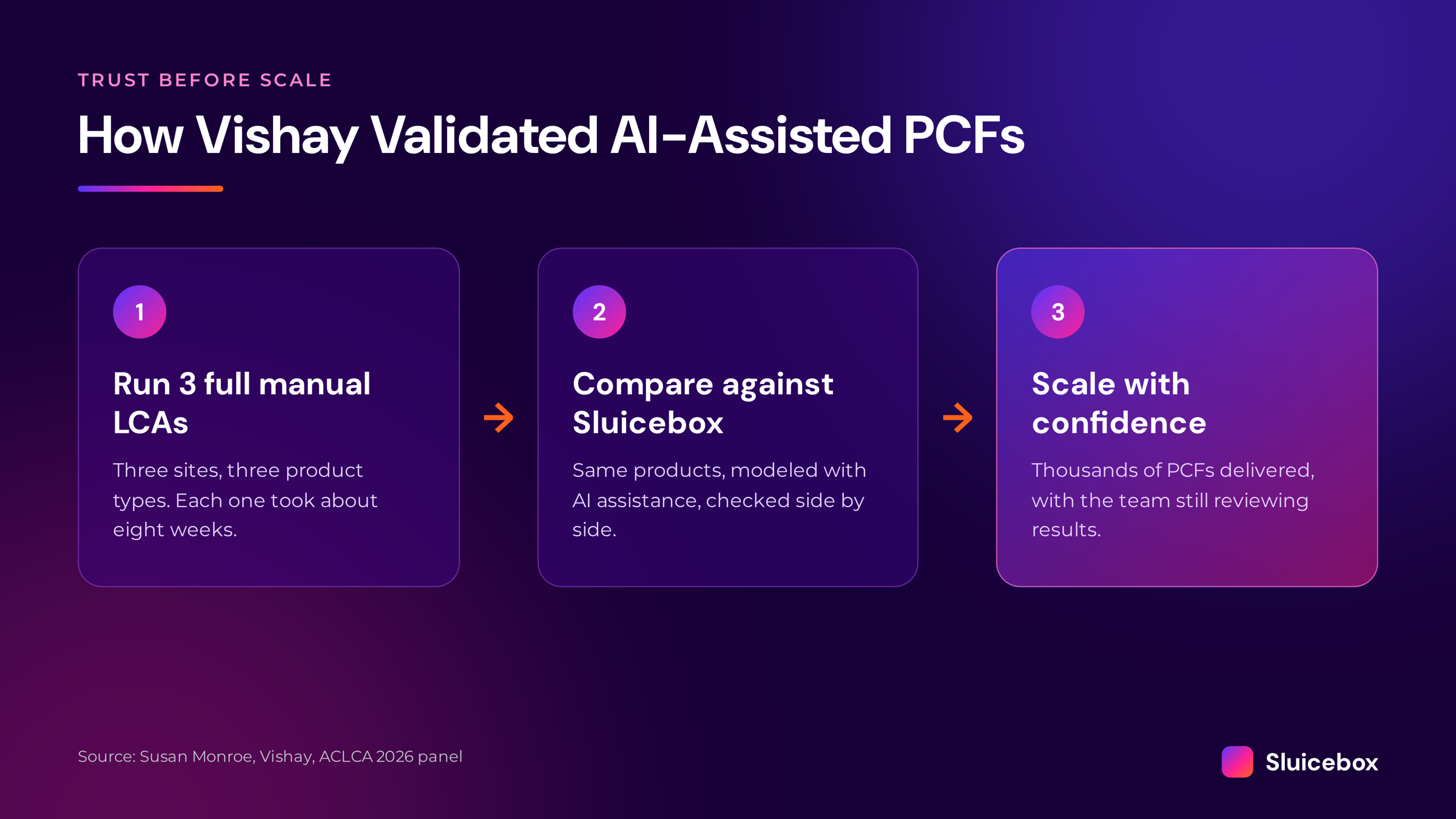
Susan was candid that she didn't take the AI results on faith. Before scaling anything, her team ran three full LCAs the traditional way, at three different sites and on three different product types. Then they compared each one with what Sluicebox produced.
Each of those manual LCAs took about eight weeks. The AI results came back much faster, and they lined up closely enough that Vishay felt comfortable moving forward.
Susan was just as careful about shortcuts from the other direction. Some customers had sent her makeshift spreadsheets asking only for a product's weight, planning to work out the footprint on their end. Susan turned those down. If a customer comes back later and asks her to cut a number by 30%, she needs to know what went into that number in the first place.
That scenario is already starting to happen. A few weeks before the conference, a customer asked Susan how much the carbon footprint would drop if they switched from one Vishay product to another. Susan called it her "aha moment." The baseline is only the start, she explained, and it has to be right, because reduction requests are what come next. There's more on this work in the Vishay customer story.
A Researcher's Test: Garbage In, Garbage Out
Kim came at the topic from a different angle, and a skeptical one by her own admission. Her team at Fraunhofer IZM is developing a pressure sensor for a municipal waste facility. Since they were designing it anyway, they wanted a quick hotspot screening early on, while the engineers could still change things based on what it showed.
Kim warned the room the story would take a minute. I reminded her they had 90.
The trouble started with the developer board. Kim found its bill of materials online and assumed the rest would be easy. It wasn't: the BOM had no materials and no mass, so it didn't get her very far. Kim ran the board through Sluicebox instead, then modeled the rest of the product twice, once with AI assistance and once the conventional way, so she could compare the two.
Kim was happy with the results, and she left the project with a better opinion of AI in LCA than she started with.
The most useful lesson came from her own mistake. Kim had labeled the material for a plastic housing with an abbreviation in parentheses. To her, it was obvious. The AI read it as something else entirely and ran with it. She only caught it when she reviewed the output, and it made her far more careful about what she puts in.
Kim's advice is to treat AI like a junior colleague. It can speed things up a lot, but someone still needs to check its work.
What's Hype
When I asked each of them to name the hype, the answers were refreshingly direct.
Susan said she wouldn't trust just any AI tool she could get her hands on. Vishay wants a system that knows their products, their sites and their geographic footprint, and that lets them see the modeling behind the number. Asking a general chatbot for a PCF? Susan would not do that.
Kim reached for a German expression that got a few smiles in the room: the eierlegende Wollmilchsau, a pig that lays eggs, grows wool and gives milk. It's the perfect farm animal, one that does everything, and that's how AI tends to get treated right now. Kim also pointed out that general chatbots struggle with repeatability. Ask the same question twice and you might get two different numbers.
What's Real
This is where the conversation got more hopeful, and where both panelists ended up in a similar place.
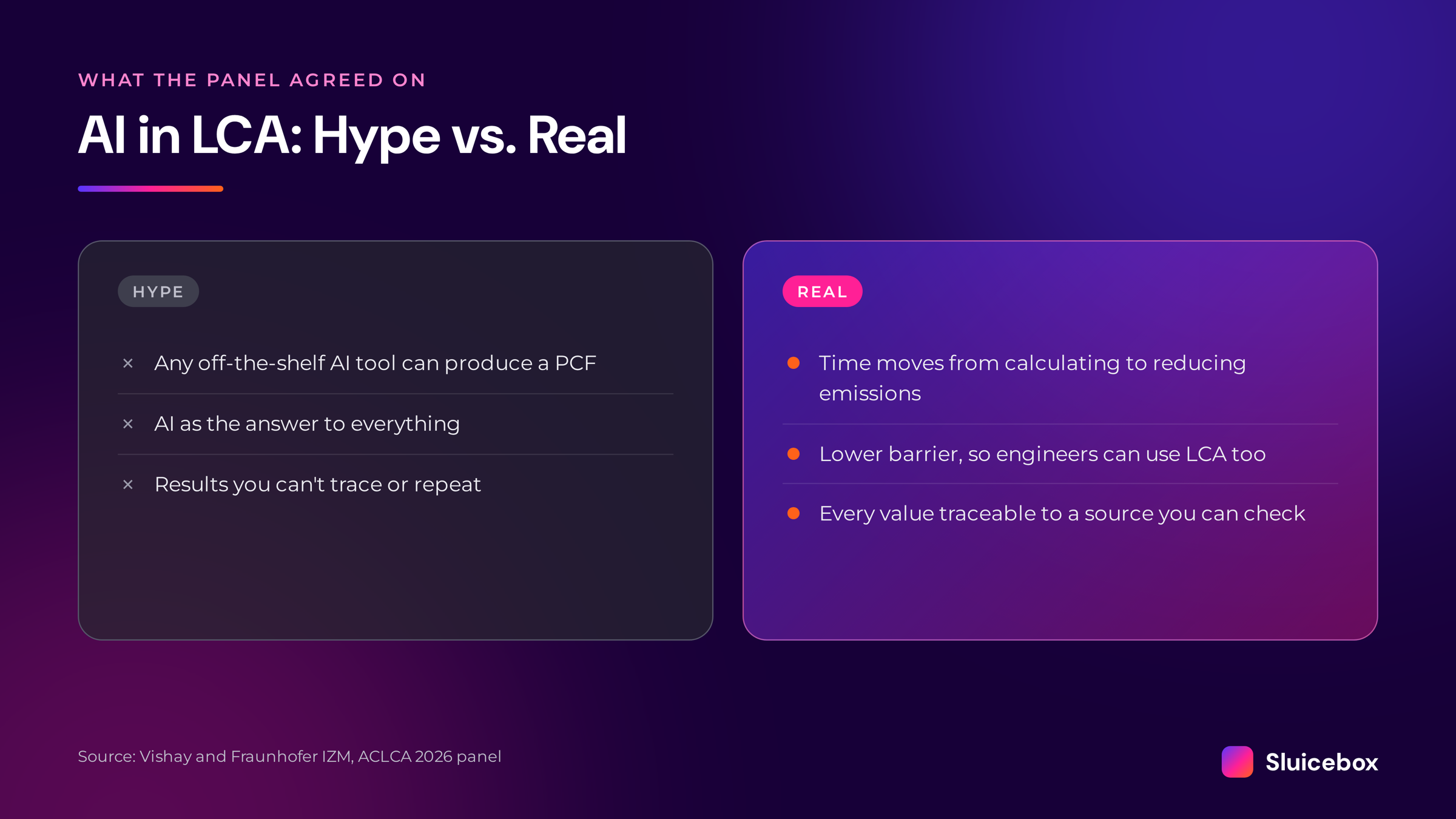
For Susan, AI changes where her team spends its energy. Instead of being tied up calculating emissions, they can look at the hotspots and start working on bringing those emissions down. Susan put it as, "Trust, but verify."
Kim sees it lowering the barrier to LCA, so engineers and people outside the field can use it too, and more people end up pulling in the same direction. When it was mentioned that half the room was probably worried about being replaced, neither of them saw it that way. Both described AI as changing where people spend their time, not taking the expertise away.
I also added the piece that holds all of this together: traceability. Every value in a Sluicebox PCF links back to its source, whether that's a datasheet, a drawing, a CAD file or sometimes just plain math. Each source carries a confidence score, so you can decide how much weight to give it. The methodology itself has been evaluated by TÜV SÜD against ISO 14040/44.
The same idea reaches upstream to suppliers. Lucy, Sluicebox's data collection agent, lets suppliers reply by email in whatever format they have, whether it's a PDF, a photo or a handwritten note. Fewer portals and questionnaires usually means more suppliers actually respond.
Trust Comes From Testing
The audience kept the questions coming for close to an hour, which says a lot about where the industry is right now. People are curious, and they want proof before they commit.
That proof won't come from bold claims. It comes from the kind of side-by-side testing Susan's team did and the careful review Kim did on her own project.
If you'd like to run that kind of test on your own products, request a demo or read the Sluicebox whitepaper.
Also, read:
About Sluicebox
Sluicebox is the Supply Chain Intelligence layer for the electronics industry — a Dynamic LCA engine designed specifically for semiconductor and electronics manufacturers, suppliers, and brands. Sluicebox automates and scales product-level carbon footprint (PCF) calculations and reporting across complex global supply chains, delivering real-time, ISO-compliant, and audit-ready carbon data for over 99% of electronic components worldwide.
Developed by engineers and scientists from NASA, Amazon, and Uber, Sluicebox empowers organizations to identify emissions hotspots, ensure regulatory compliance, and build trusted sustainability disclosures — eliminating the cost and complexity of manual life cycle assessments.
More news
 Industry Analysis
An EPD costs $24,000 and ten weeks. AI is changing the math.
 Miguel Altamirano5 min readJune 10, 2026
 Press Coverage
TÜV SÜD evaluates AI-based LCA software
 TÜV SÜD10 min readNovember 26, 2025
 AI & Engineering
Distance From the Outcome: Why AI Threatens Some and Supercharges Others
 Adrien Brault12 min readFebruary 4, 2026